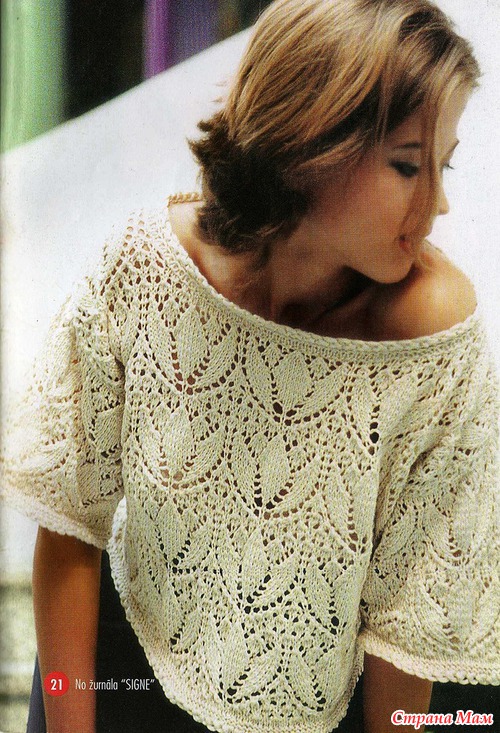
Large Tulip Lace.
Translation of Above Text:
Materials: 250 g cotton yarn
Needles: No. 3
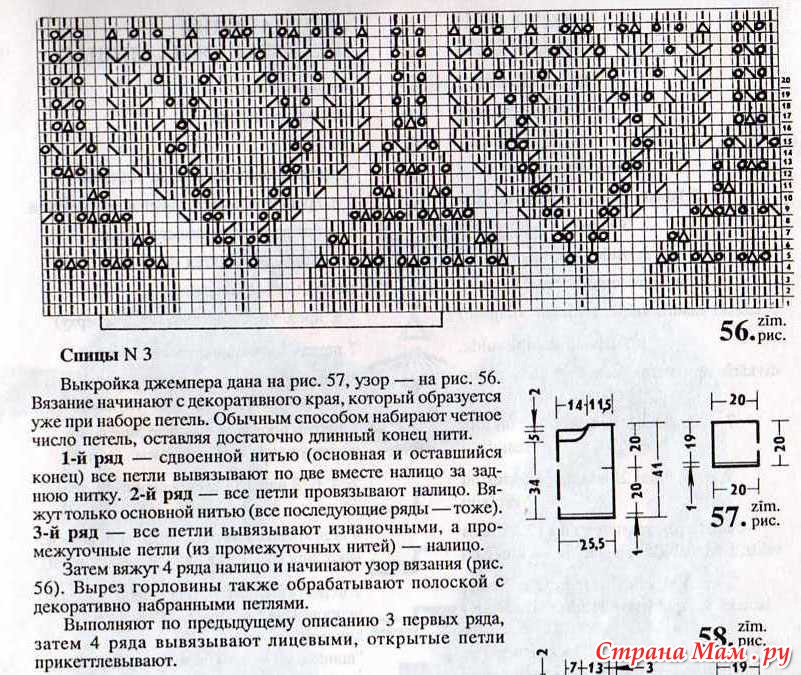
The jumper pattern is shown in Fig. 57, and the stitch pattern in Fig. 56. Knitting begins with a decorative edge that forms as you cast on. Cast on an even number of stitches using the standard cast-on method, leaving a long tail of yarn.
Row 1: Using a double strand of yarn (the main yarn and the long tail), knit all stitches two together through the back loop.
Row 2: Knit all stitches using only the main yarn. (Continue knitting all following rows with the main yarn only.)
Row 3: Purl all stitches, knitting the stitches that form between the purl stitches (from the connecting strands).
Then knit 4 rows in stockinette stitch (knit on the right side, purl on the wrong side) and begin the pattern shown in Fig. 56.
The neckline is finished with a decorative cast-on edge as well. Work the first 3 rows as described above, then knit 4 rows, and graft the live stitches neatly to finish.
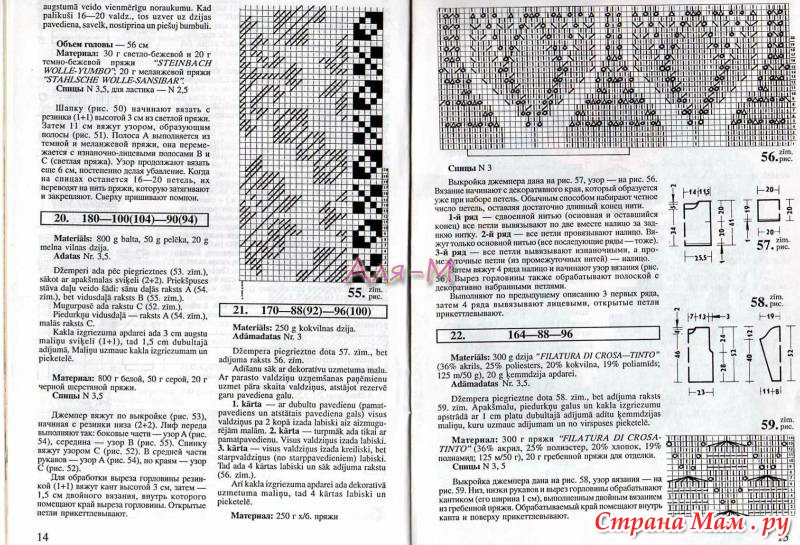
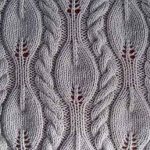
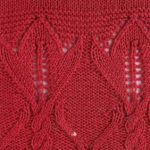
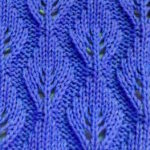
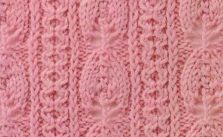
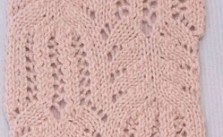
This pattern doesn’t correspond the photograph. The side leafs of the tulips have holes following their outline but not on the pattern. Also, the whole sweater has knits on the face while the pattern has both, knits and purls.
I think there is space between the tulip motifs in the chart that doesn’t correspond with any stitches. So, in the chart, they left empty squares between some of the stitches to make the chart easier to read.
I was having a really difficult time with this pattern, as it didn’t seem to work as written, but I think I’ve figured out how to fix it, so I thought I’d share!
Taking the vertical lines to represent stockinette stitches (k on rs, p on ws), the circles as YO, the diagonal slashes (/ and \) to mean k2tog and ssk respectively, the triangles as s1-k2tog-psso (or your preferred symmetrical 3:1 decrease), and the empty squares to represent a LACK of stitches, the only changes that need to be made are:
– on wrong-side (even numbered) rows, wherever the pattern says to p2tog into the second loop of a double YO, instead do either a twisted stitch (pbl), or do a regular stitch and make the stitch BEFORE it reverse stockinette (i.e., while purling, knit the first loop of the double YO, and then purl the second)
– in the second-last row (row 25), excluding the initial k1-YO-ssk and final k2tog-YO-k1, work the entire row in a pattern of YO, 3:1, YO, k1 (instead of randomly adding one extra 3:1 decrease on each flower for no reason) (so, essentially, add a YO and a k1 to the pattern in the empty squares to the right of the two random triangles on the chart)
– and then just purl the whole way across row 26, no need to count
Also, to save anyone else the trouble of counting: when casting on for this pattern, you need 20 stitches per horizontal repeat, +5 for the outro, and a margin of at least one stitch on either side if you’re planning to follow the pattern as written including the decreases and YOs right at the edges.
Hope this helps someone else make good use of this pattern!