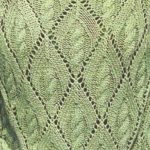
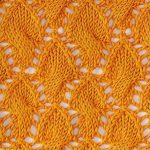
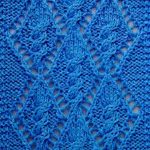
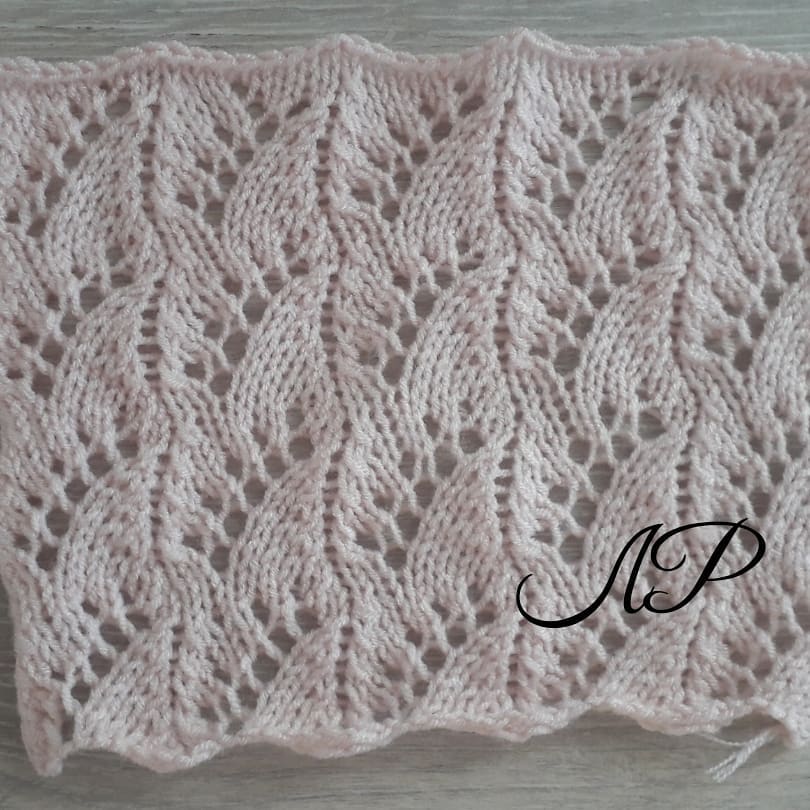
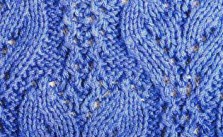
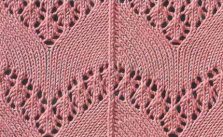
The Interlocking Twisted Cable Knitting Stitch creates a dense geometric texture of small left- and right-leaning twists that cross and change direction across the fabric. The result resembles miniature interlocking cables or lattice shapes, with columns of knit and purl stitches providing definition between the motifs.
This textured knitting stitch is worked over a multiple of 4 stitches plus 10 with an 8-row repeat. Despite its intricate appearance, the twists are worked directly from the needles without a cable needle.

Pattern Details
- Stitch Multiple: Multiple of 4 + 10 stitches
- Row Repeat: 8 rows
- Techniques: Knit, purl and twisted stitches
- Worked Flat: Yes
Abbreviations
- k: knit
- p: purl
- st(s): stitch(es)
- t2R: twist 2 right
- t2L: twist 2 left
- t2Rp: twist 2 right with knit and purl stitches
- t2Lp: twist 2 left with purl and knit stitches
- RS: right side
How to Work the Twists
t2R (twist 2 right): Knit into the front of the second stitch on the left needle, then knit into the back of the first stitch. Slip both stitches off the left needle together.
t2L (twist 2 left): Knit into the back of the second stitch on the left needle, then knit into the front of the first stitch. Slip both stitches off the left needle together.
t2Rp: Knit into the front of the second stitch on the left needle, then purl into the front of the first stitch. Slip both stitches off the left needle together.
t2Lp: Purl into the back of the second stitch on the left needle, then knit into the front of the first stitch. Slip both stitches off the left needle together.
Interlocking Twisted Cable Stitch Pattern
Cast on a multiple of 4 stitches + 10.
Row 1 (RS): p2, *t2R, p2; repeat from * to end.
Row 2: k2, *p2, k2; repeat from * to end.
Row 3: p2, k1, *t2Lp, t2Rp; repeat from * to last 3 sts, k1, p2.
Row 4: k2, p1, k1, *p2, k2; repeat from * to last 6 sts, p2, k1, p1, k2.
Row 5: p2, k1, p1, *t2L, p2; repeat from * to last 6 sts, t2L, p1, k1, p2.
Row 6: repeat Row 4.
Row 7: p2, k1, *t2Rp, t2Lp; repeat from * to last 3 sts, k1, p2.
Row 8: repeat Row 2.
Repeat Rows 1–8 for the pattern.
Helpful Knitting Notes
The direction of the twists changes throughout the right-side rows, which creates the interlocking appearance of the pattern. Once the first 8-row repeat is established, the position of the surrounding knit and purl stitches makes it easier to see where each twist belongs.
The t2R and t2L instructions twist two knit stitches in opposite directions. The t2Rp and t2Lp instructions combine a knit and purl stitch within the twist, allowing the textured motif to move across the knit and purl background.
All of these twists are worked without a cable needle. Keep both stitches on the left needle while working them in the specified order, then slip both stitches from the needle together.
On the wrong-side rows, the knit and purl stitches maintain the established texture. Rows 6 and 8 simply repeat earlier wrong-side rows, making the 8-row pattern easier to remember.
Keep your tension reasonably relaxed when working the twists. If the stitches are too tight, inserting the needle into the second stitch can become difficult.
Choosing Your Cast-On Number
Use:
4 × number of repeats + 10 stitches
- 14 sts
- 18 sts
- 22 sts
- 26 sts
- 30 sts
- 34 sts
A smooth yarn with good stitch definition is particularly effective for this pattern because it makes the small travelling twists and interlocking geometric shapes much easier to see.