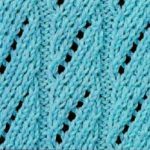
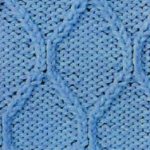
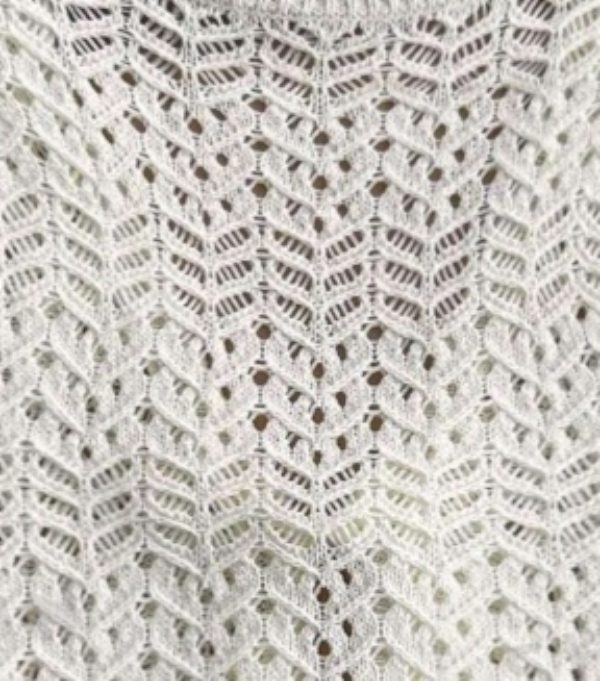
The Twisted Rib Cable Knitting Stitch creates a firm, deeply textured rib using small left- and right-twisting stitches separated by a single twisted knit stitch. The alternating twists give the fabric a miniature cable appearance while maintaining the elasticity and structure of ribbing.
Worked over a multiple of 6 stitches plus 1 with a simple 2-row repeat, this textured rib stitch is a good choice for sweater panels, cuffs, scarves, hats, cardigans and other projects where you want a decorative alternative to ordinary ribbing.

Pattern Details
- Stitch Multiple: Multiple of 6 + 1 stitches
- Row Repeat: 2 rows
- Techniques: Knit, purl, twisted stitches and left- and right-twisting stitches
- Worked Flat: Yes
Abbreviations
- k: knit
- p: purl
- tbl: through back loop
- ktbl: knit through the back loop
- ptbl: purl through the back loop
- t2R: twist 2 right
- t2L: twist 2 left
- RS: right side
- st(s): stitch(es)
How to Work t2R
t2R (twist 2 right): Knit into the front of the second stitch on the left needle, then knit into the back of the first stitch. Slip both stitches off the left needle together.
How to Work t2L
t2L (twist 2 left): Knit into the back of the second stitch on the left needle, then knit into the front of the first stitch. Slip both stitches off the left needle together.
Twisted Rib Cable Stitch Pattern
Cast on a multiple of 6 stitches + 1.
Row 1 (RS): *p1, t2R, ktbl, t2L; repeat from * to last st, p1.
Row 2: k1, *p2, ptbl, p2, k1; repeat from * to end.
Repeat Rows 1–2 for the pattern.
Helpful Knitting Notes
The right-side row creates the decorative texture. t2R and t2L make small twists that lean in opposite directions, while the single ktbl stitch between them forms a firm central rib.
These twists are worked without a cable needle. Both stitches remain on the left needle while you work into them in the required order, then both are slipped from the needle together.
The wrong-side row maintains the structure of the rib. The ptbl stitch corresponds with the twisted knit stitch on the right side and helps keep that central column crisp and well defined.
When first working the twists, keep your tension fairly relaxed. Knitting into the second stitch while both stitches remain on the left needle can feel tight if the previous row has been worked too firmly.
Choosing Your Cast-On Number
Use:
6 × number of repeats + 1 stitch
- 1 repeat: 7 sts
- 2 repeats: 13 sts
- 3 repeats: 19 sts
- 4 repeats: 25 sts
- 5 repeats: 31 sts
- 6 repeats: 37 sts
Using This Twisted Rib Stitch
This stitch produces a firm, stable textured rib rather than the flatter appearance of standard k1, p1 or k2, p2 ribbing. The combination of left and right twists gives the surface a small cable-like texture without requiring traditional cable crosses.
A smooth yarn with good stitch definition will show the twisted columns particularly clearly.