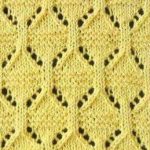
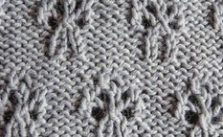
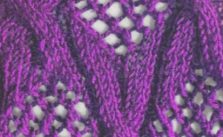
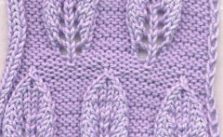
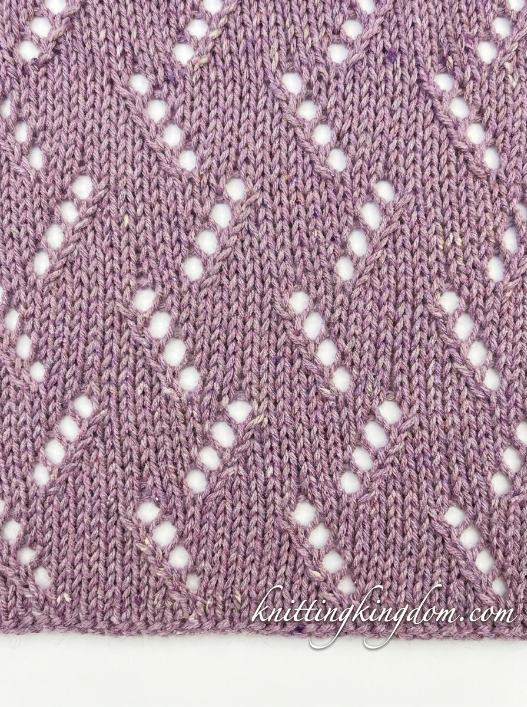
The Travelling Eyelet Knitting Stitch is an easy lace pattern that creates a single line of eyelets moving diagonally across the knitted fabric before travelling back in the opposite direction. The result is a subtle zigzag or wave of small eyelets against a smooth stockinette background.
Worked over a 9-stitch repeat with 16 rows, this simple eyelet knitting pattern uses basic yarn overs and decreases. It is a good choice for lightweight tops, scarves, shawls, baby knits, blankets and decorative panels when you want a little openwork without a heavily laced fabric.
Pattern Details
- Stitch Repeat: Multiple of 9 stitches
- Row Repeat: 16 rows
- Techniques: Knit, purl, yarn over and decreases
- Worked Flat: Yes
Abbreviations
- k: knit
- p: purl
- yo: yarn over
- skpo: slip 1 stitch knitwise, knit 1, pass the slipped stitch over
- k2tog: knit 2 stitches together
- st(s): stitch(es)
- RS: right side
Travelling Eyelet Written Pattern
Cast on a multiple of 9 stitches.
Row 1 (RS): *k4, yo, skpo, k3; repeat from * to end.
Row 2 and every alternate row: purl to end.
Row 3: *k5, yo, skpo, k2; repeat from * to end.
Row 5: *k6, yo, skpo, k1; repeat from * to end.
Row 7: *k7, yo, skpo; repeat from * to end.
Row 8: purl to end.
Row 9: *k3, k2tog, yo, k4; repeat from * to end.
Row 10: purl to end.
Row 11: *k2, k2tog, yo, k5; repeat from * to end.
Row 12: purl to end.
Row 13: *k1, k2tog, yo, k6; repeat from * to end.
Row 14: purl to end.
Row 15: *k2tog, yo, k7; repeat from * to end.
Row 16: purl to end.
Repeat Rows 1–16 for the pattern.
Stitch Count Check
Every right-side pattern row uses exactly 9 stitches per repeat.
For example:
Row 1: k4 + yo + skpo + k3
The skpo consumes 2 stitches and produces 1, while the yo creates 1 new stitch. The decrease and increase therefore balance each other:
9 stitches in → 9 stitches out.
The same balance occurs on Rows 3, 5 and 7.
In the second half of the pattern, k2tog replaces skpo. Again, each k2tog decreases one stitch and the accompanying yo adds one stitch, so Rows 9, 11, 13 and 15 also maintain the original stitch count.
There are no increases or decreases to the overall number of stitches anywhere in the 16-row repeat.
Helpful Knitting Notes
The first half of the pattern uses skpo, a left-leaning decrease. The position of the yarn over and decrease moves one stitch across the repeat on Rows 1, 3, 5 and 7, creating the first diagonal line of eyelets.
In the second half, the pattern switches to k2tog, a right-leaning decrease. Rows 9, 11, 13 and 15 move the eyelets back across the repeat in the opposite direction.
Using decreases that lean in opposite directions helps the knitted fabric follow the movement of the eyelets and gives the finished zigzag a neater appearance.
The original pattern uses yfd (yarn forward). This has been written as the modern yo (yarn over) in the instructions above.
Choosing Your Cast-On Number
Use a multiple of 9 stitches:
- 1 repeat: 9 sts
- 2 repeats: 18 sts
- 3 repeats: 27 sts
- 4 repeats: 36 sts
- 5 repeats: 45 sts
- 6 repeats: 54 sts
Finishing Tip
Gentle blocking will open the small eyelets and make the travelling diagonal line easier to see. Because most of the fabric is stockinette stitch, the finished result remains relatively solid while the eyelets provide a delicate decorative detail.