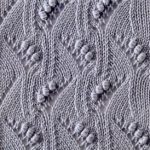
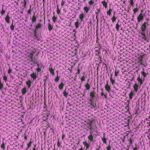
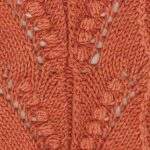
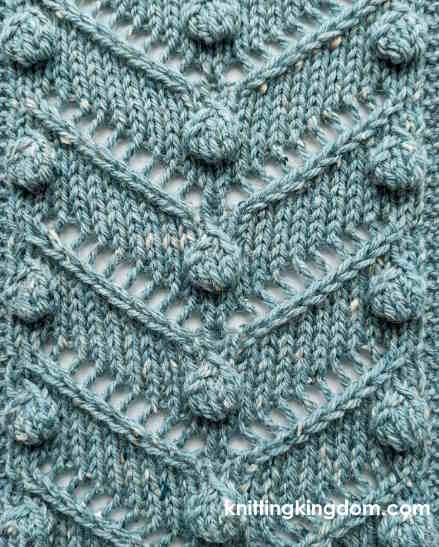
The Chevron Bobble Stitch combines textured bobbles with an eyelet chevron pattern to create a striking geometric knitted fabric. Lace decreases and yarn overs form the strong zigzag lines, while raised bobbles sit between the chevrons for extra texture.
This chevron knitting stitch pattern is worked over a multiple of 20 stitches plus 1 with a 10-row repeat. It is a beautiful decorative stitch for knitted blankets, cushion covers, scarves, sweaters and textured panels.
Pattern Details
- Stitch Multiple: Multiple of 20 + 1 stitches
- Row Repeat: 10 rows
- Techniques: Knit, purl, yarn over, decreases and bobbles
Abbreviations
- k: knit
- p: purl
- st(s): stitch(es)
- yo: yarn over
- sl 1: slip 1 stitch knitwise
- psso: pass slipped stitch over
- k2tog: knit 2 stitches together
- p2tog: purl 2 stitches together
- p2tog tbl: purl 2 stitches together through the back loops
How to Make the Bobble
Make bobble: (k1, yo, k1, yo, k1) all into the next stitch, turn, p5, turn, k5, turn, p2tog, p1, p2tog, turn, sl 1, k2tog, psso.
The bobble begins with one stitch, temporarily increases to five stitches and is then decreased back to one stitch. The work is turned several times while making the bobble, so complete the entire bobble before continuing along the main pattern row.
Chevron Bobble Written Pattern
Cast on a multiple of 20 stitches + 1.
Row 1: k1, *yo, sl 1, k1, psso, k15, k2tog, yo, k1; repeat from * to end.
Row 2: p2, *yo, p2tog, p13, p2tog tbl, yo, p3; repeat from * to last 19 sts, yo, p2tog, p13, p2tog tbl, yo, p2.
Row 3: k3, *yo, sl 1, k1, psso, k11, k2tog, yo, k5; repeat from * to last 18 sts, yo, sl 1, k1, psso, k11, k2tog, yo, k3.
Row 4: *yo, p2tog, p9, p2tog tbl, yo, p7; repeat from * to last 17 sts, yo, p2tog, p9, p2tog tbl, yo, p4.
Row 5: k5, *yo, sl 1, k1, psso, k3, make bobble, k3, k2tog, yo, k9; repeat from * to last 16 sts, yo, sl 1, k1, psso, k3, make bobble, k3, k2tog, yo, k5.
Row 6: *yo, p2tog, p5, p2tog tbl, yo, p11; repeat from * to last 15 sts, yo, p2tog, p5, p2tog tbl, yo, p6.
Row 7: k7, *yo, sl 1, k1, psso, k3, k2tog, yo, k6, make bobble, k6; repeat from * to last 14 sts, yo, sl 1, k1, psso, k3, k2tog, yo, k7.
Row 8: p8, *yo, p2tog, p1, p2tog tbl, yo, p15; repeat from * to last 13 sts, yo, p2tog, p1, p2tog tbl, yo, p8.
Row 9: k9, *yo, sl 1, k1, k2tog, psso, yo, k17; repeat from * to last 12 sts, yo, sl 1, k2tog, psso, yo, k9.
Row 10: purl to end.
Repeat Rows 1–10 for the pattern.
Helpful Knitting Notes
The chevron shape develops gradually as the yarn overs and decreases move across the fabric. The eyelets define the diagonal edges, eventually meeting to form the distinctive V-shaped chevrons.
The bobbles are worked on Rows 5 and 7. This particular bobble is made by increasing one stitch to five stitches and working several short rows over those stitches before decreasing them back to one. When the bobble is complete, continue working the main row from where you left off.
On Row 9, pay particular attention to the double decrease. The sequence is worked differently from the decreases on the previous right-side rows and helps bring the two sides of the chevron together.
The bobble itself begins and ends with one stitch, so it does not change the overall stitch count.
Because this pattern combines yarn overs, several types of decreases and turned bobbles, stitch markers placed between the 20-stitch repeats can be helpful while the pattern is becoming familiar.
Choosing Your Cast-On Number
Use:
20 × number of repeats + 1 stitch
- 1 repeat: 21 sts
- 2 repeats: 41 sts
- 3 repeats: 61 sts
- 4 repeats: 81 sts
- 5 repeats: 101 sts
Finishing Tip
Blocking helps open the yarn-over eyelets and makes the diagonal chevron lines much more distinct. A smooth, solid-coloured yarn will also make both the lace structure and the raised bobbles easier to see.