Unique Lace Leaf Knitting Stitch. An original take on the lace leaf with one stitch being the odd one out in reverse stockinette.
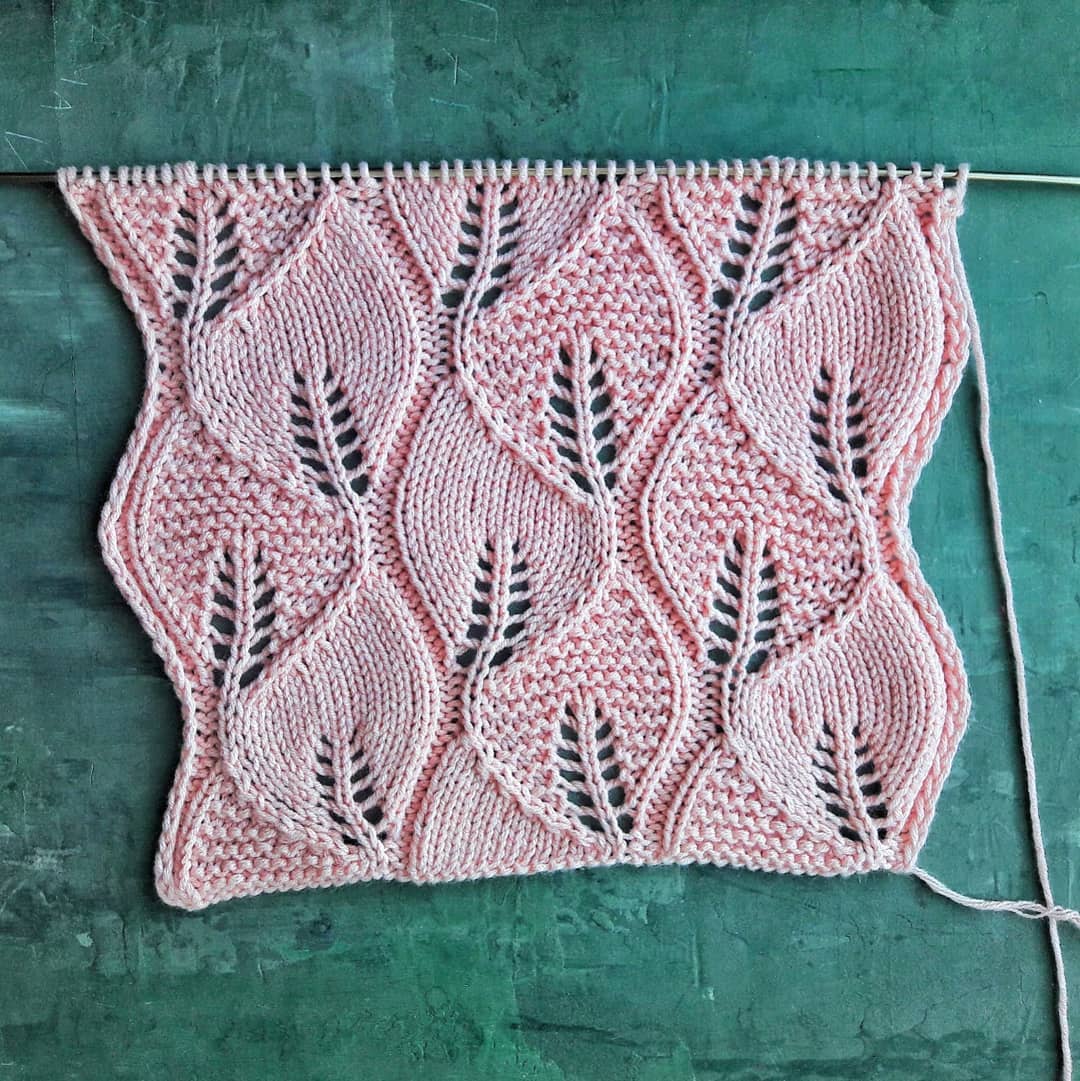
Unique Lace Leaf Knitting Stitch. An original take on the lace leaf with one stitch being the odd one out in reverse stockinette.
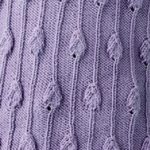
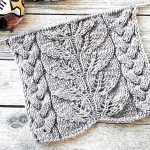
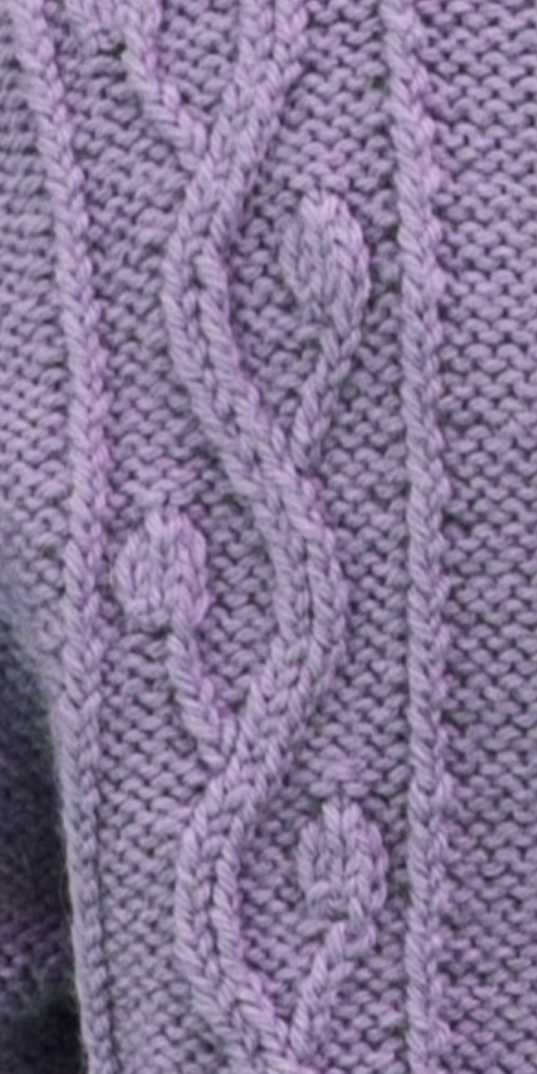
Buds on a Vein Knitting Stitch. More Great Patterns Like This
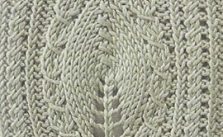
Large Leaf and Twists Knitting Panel. More Great Patterns Like This
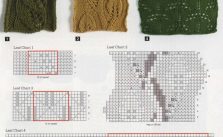
Leaf Knitting in Many Ways. More Great Patterns Like This
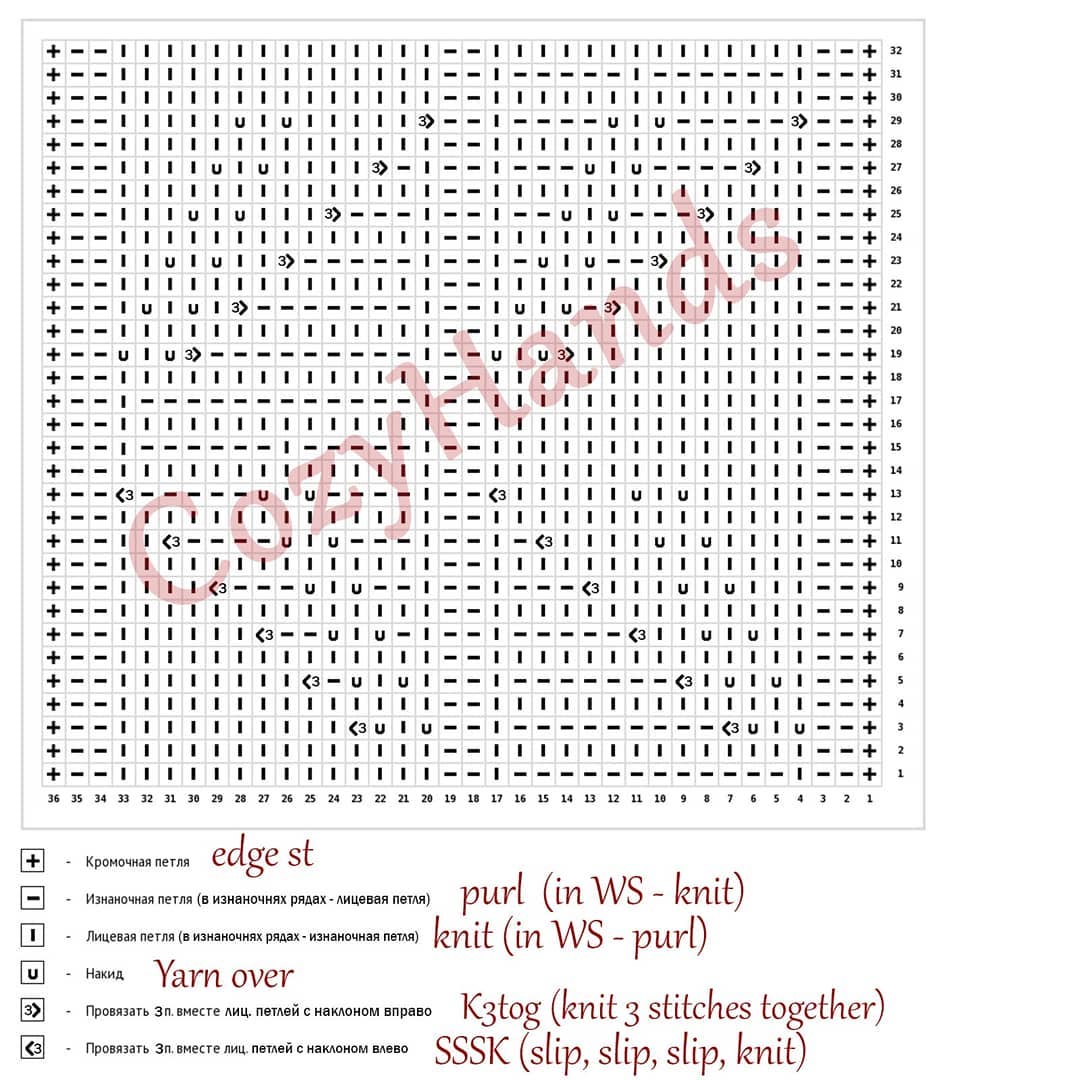
What is the cast on amount ?? Does the pattern start on the wrong or right side ?
I would read this as cast on multiples of 34 +2 (edge stitches). Someone better at maths might be able to work out where to break for different stitch numbers. The usual convention is the first row is right side unless otherwise stated.
to work this swatch cast on 36 stitches. The pattern starts on the right side.
From the pattern, it looks like it’s multiples of 16 +2
This image has 32 + 2 + 2 edge stitches.
About the right side or wrong side, I’d stitch up two samples and check which one works. If you do, please add the details to the comments so that the community could benefit. Good luck!
Looking at the sample piece, Row 1, the RS is:
Sel stitch, *P2,K1,P12,K1*,P2,Sel stitch
Is it possible to get a written pattern for the Japanese lace
Wow, this is an amazing pattern and a wonderful site to find. Thank you for everything you do to keep us knitters busy.
Thank you!
Are the back rows (2, 4, 6, etc.) really right? I mean, if I knit them, the pattern would look different to the sample.
The pattern is beautiful but not correct. You dont get the middle of the leave and edges of leaves like in a picture. I will adjust the pattern, but it would be nice to have correct one
Did you figure out the correct pattern from the presented picture? I am a learner and can’t figure it out by myself, but would be very grateful if you shared your corrections.
Hi Emma
Did you manage to adjust the pattern to be correct. I also fell in love with this pattern and tried to adjust it but couldn’t.
Michele
I think the pattern is correct – the lady is just a very neat knitter. Also, i think she’s knitting on or under the recommended needle size – she hasn’t increased the needle size for lace. The chart is for 2 repeats – the picture shows 3 – so CO 53 sts for 3 columns (17 x 3 + 2 selvage sts). What I want to know is why the pattern uses reverse garter stitch (purl every row) – instead of garter? Sure, it’s easier in this pattern because you can just purl the back all the way through – no thinking required (hardly, there are a ew knit stitches in a column), also it’s easier to see on the front what you’re doing. It seems looser- and better balanced than garter stitch proper – and not as tight – so doesn’t mess up the shape of the overall piece as much as garter, which condenses rows quite a bit. Maybe I’ve just answered my own question – but I just wanted to know what the wisdom is behind making the knitter purl so much, if the fabric produced is allegedly the same as garter stitch … ? What do cozy hands know about reverse garter stitch that we don’t?
Actually, I miscounted earlier, it’s a
16 + 2 (+2 selvage) stitches pattern,
so cast on (16 x 3 = 48 + 2 + 2 selvage =) 52 stitches
to replicate the 3 columns shown …
It is so kind for whoever created this design to have it translated in English.
KUDOS to you!!! What a beautiful design this is to knit
Thank you kindly.
Loretta
This is a beautiful stitch and I really want to master it and use it to make a shawl for my first grandchild expected in a few months time.
I am an experienced knitter, but I am really struggling with this pattern, really because I prefer written instructions. I am trying to write them out to share. Perhaps someone who has made this can help.
Maybe I am being stupid but the chart shows 36 stitches. After row 3, there will be 40 stitches because you have yon x 4, so added 4 stitches. Row 4 then shows how to work over 36 stitches. What do you do with the additional 4 stitches, please?
Cracked it!
You asked whether anyone could help with written instructions. I believe this is correct but I am happy to take a correction if I have made an error:
Cast on a multiple of 32 +2 stitches plus selvedge (in this case, 2 stitches).
Row 1: K1, p2, (k1, p12, k1, p2, k14, p2) to the last st. K1.
Row 2 and each alternative row: P1, (k2, p14) to last 3 sts. K2, p1.
Row 3: K1, p2, (yo, k1, yo, SSSK, p9, k1, p2, yo, k1, yo, SSSK, k10, p2) to the last st. K1.
Row 5: K1, p2, (k1, yo, k1, yo, k1 SSSK, p7, k1, p2, k1, yo, k1, yo, p1, SSSK, k8, p2) to the last st. K1.
Row 7: K1, p2, (k2, yo, k1, yo, p2, SSSK, p5, k1, p2, k1, p1, yo, k1, yo, p2, SSSK, k6, p2) to the last st. K1.
Row 9: K1, p2, (k3, yo, k1, yo, k3, SSK, p3, k1, p2, k1, p2, yo, k1, yo, p3, SSSK, k2, p2) to the last st. K1.
Row 11: K1, p2, (k4, yo, k1, k4, SSK, p1, k1, p2, k1, p3, yo, k1, yo, p4, SSSK, k2, p2) to the last stitch. K1.
Row 13: K1, p2, (k5, yo, k1, yo, k5, SSSK, p2, k1, p4, yo, k1, yo, p5, SSSK, p2) to the last st. K1.
Row 15: K1, p2, (k14, p2, k1, p5, k1, p6, k1, p2) to the last st. K1.
Row 17: K1, p2, (k14, p2, k1, p12, k1, p2) to the last st. K1.
Row 19: K1, p2, (k10, k3 tog., yo, k1, yo, p2, k1, p9, k3 tog., yo, k1, yo, p2) to the last st. K1.
Row 21: K1, p2, (k8, k3 tog., p1, yo, k1, yo, k1, p2, k1, p7, k3 tog., k1, yo, k1, yo, k1, p2) to the last st. K1.
Row 23: K1, p2, (k6, k3 tog., p2, yo, k1, yo, p1, k1, p2, k1, p5, k3 tog., k2, yo, k1, yo, k2, p2) to the last st. K1.
Row 25: K1, p2, (k4, k3 tog., p3, yo, k1, yo, p2, k1, p2, k1, p3, k3 tog., k3, yo, k1, yo, k3, p2) to the last st. K1.
Row 27: K1, p2, (k2, k3 tog., p4, yo, k1, yo, p3, k1, p2, k1, p1, k3 tog., k4, yo, k1, yo, k4, p2) to the last stitch. K1.
Row 29: K1, p2, (k3 tog., p5, yo, k1, yo, p4, k1, p2, k 3 tog., k5, yo, k1, yo, k5, p2) to the last st. K1.
Row 31: K1, p2, (k1, p6, k1, p5, k1, p2, k14, p2) to the last st. K1.
Row 32: As row 2.
These 32 rows form the pattern.
I plan to use the stitch on a baby shawl. If I do, I will share my finished article and credit this site.
that is wonderful, thankyou!